24/7 Emergency Care

header left arrow

/

English

/

RU

Online Contact

Hot Plate Welding

PRODUCTS CENTER

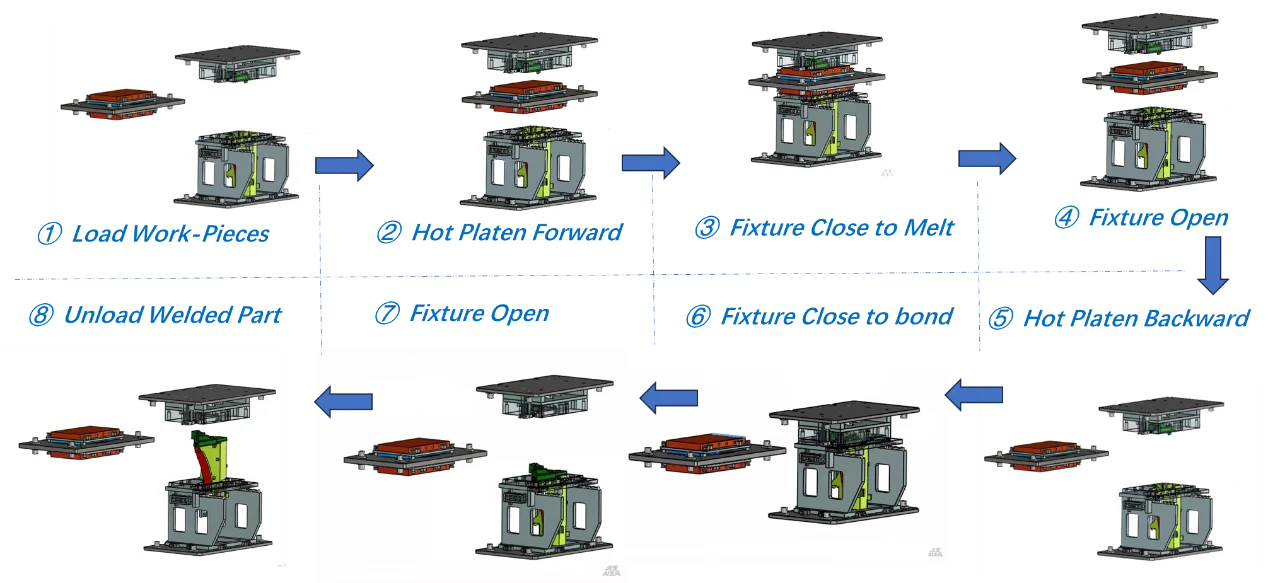
Hot plate welding is a kind of thermoplastic joining method which uses heated metal platens to melt the joining surface of two plastic halves, then keeps two plastic halves pressed together under pressure until molten material became resolidified and form permanent molecular bond.
Hot plate welding offers high joint strength, excellent hermetic sealing, reliable repeatability and airtightness. It can be applied for the joining to thermoplastic parts in large size or complex-shape.

The steps of hot plate welding
Hot Plate Welder ()
Hot Plate Welder ()
Key Advantages Hot Plate Welding:
1. Superior Welding performance: high welding strength and airtight sealing, meeting challenging requirement;
2. Super Welding Capability and Possibility: ideal for large parts, dual-shell designs and intricate 3D contours;
3. Broad Material Compatibility: workable with almost thermoplastics, especially semi-crystalline ones like PP and PE, and can also join some dissimilar materials;
4. Stable & Repeatable Quality: Process parameters (temperature, time, pressure & depth) are precisely controllable;
5. Good Tolerance Accommodation: Compensates well for dimensional variations from prior processes like injection molding.
The Key Components:
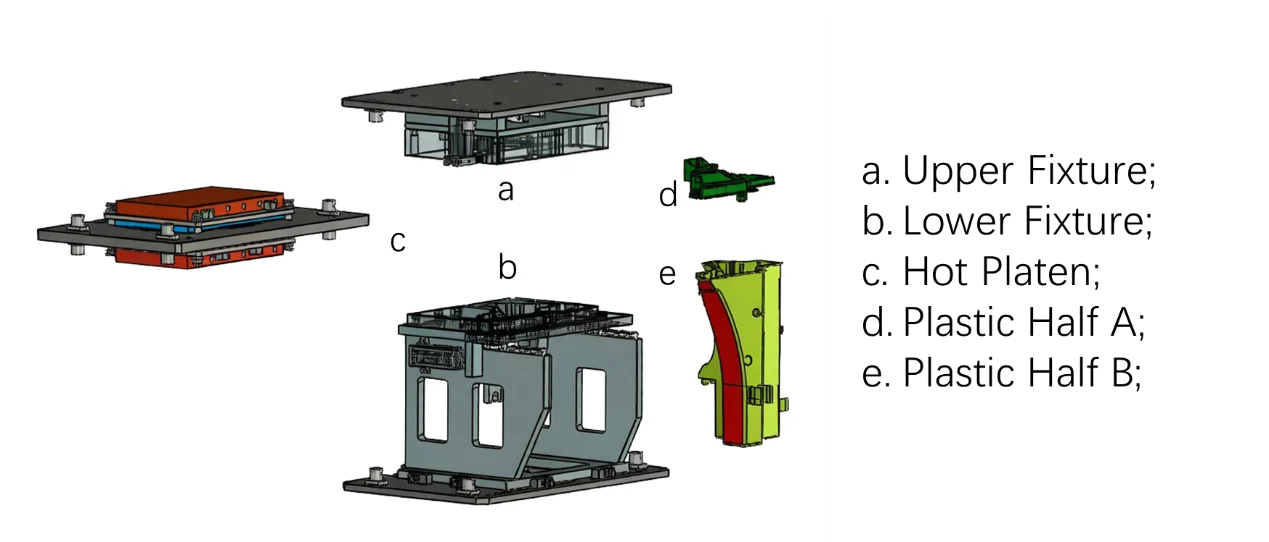
1. Clamping Fixture: position plastic work-pieces and ensure its precision alignment, mostly material is Aluminum for light weight;
2. Heating Tool: Hot platen for melting plastic material, normally made in aluminum, copper (such as bronze), Iron or steel;
3. Pressure System: pneumatic system, hydraulic system or servo system;
4. Temperature Control System: Heaters, temperature sensor, heating power supply system, temperature regulation system (temperature regulators or temperature control PLC module), etc.
 

Speed

Precision

Max Force

Stability

Environment Pollution

Pneumatic

Medum

Low-control precision is low. Position control is mechanical, speed and force control by regulator

Low-depends

Low-impacted by air source deeply


Servo

Fast

High- can precision control peed, motion distance, torque and stop position

Medium

High

Pure Electrical energy

Hydraulic

Low

High- can precision control peed, motion distance, torque and stop position

High

High

Wasted hydraulic cased after replacement

Critical Parameters:
1. Melting temperature: normally from 150°C to 500°C, depends on material;
2. Hot Platen Melting Pressure: the pressure forcing plastic halves onto hot platen;
3. Fusing Pressure: the pressure forcing two plastic halves together until material cool down to resolidify and form joining. Note:the pressure needs to according to material, welding area size, parts size and geometric shape design as well as fixture weight, etc. And normally pressure value is not constant but dynamic according to material manner.
4. Melting depth: the fixtures motion distance during hot platen melting;
5. Fusing depth: the fixture Note: the depths control should ensure enough molten material replacement to ensure enough bonding to reach target welding strength and airtightness;
6. Meling time: the time of hot platen heating to plastic material until the melting reach to target volume;
7.Fusing time: means cooling time, which machine keeps two plastic halves pressed together until temperature cools down and forms bonding.
It is very important that temperature, force pressure, depth and time should be controlled in co-working, but not independently. Moreover, to achieve perfect operation result and operation efficiency, the motion speed of machine should be controlled accordingly in different steps, thus it is necessary to Consider the precision control of fixture motion speed and hot platen motion speed as well as tooling change-over time.


MP SONIC HOT PLATE WELDER SPECIFICATION